
Mindoxa Supplement Facts: What the Panel Must Show, What Is Public, What Is Missing
No panel with amounts is published. Here is everything that can be read, the federal rules a mushroom panel follows, and a ten-question worksheet for the bottle in your hand.
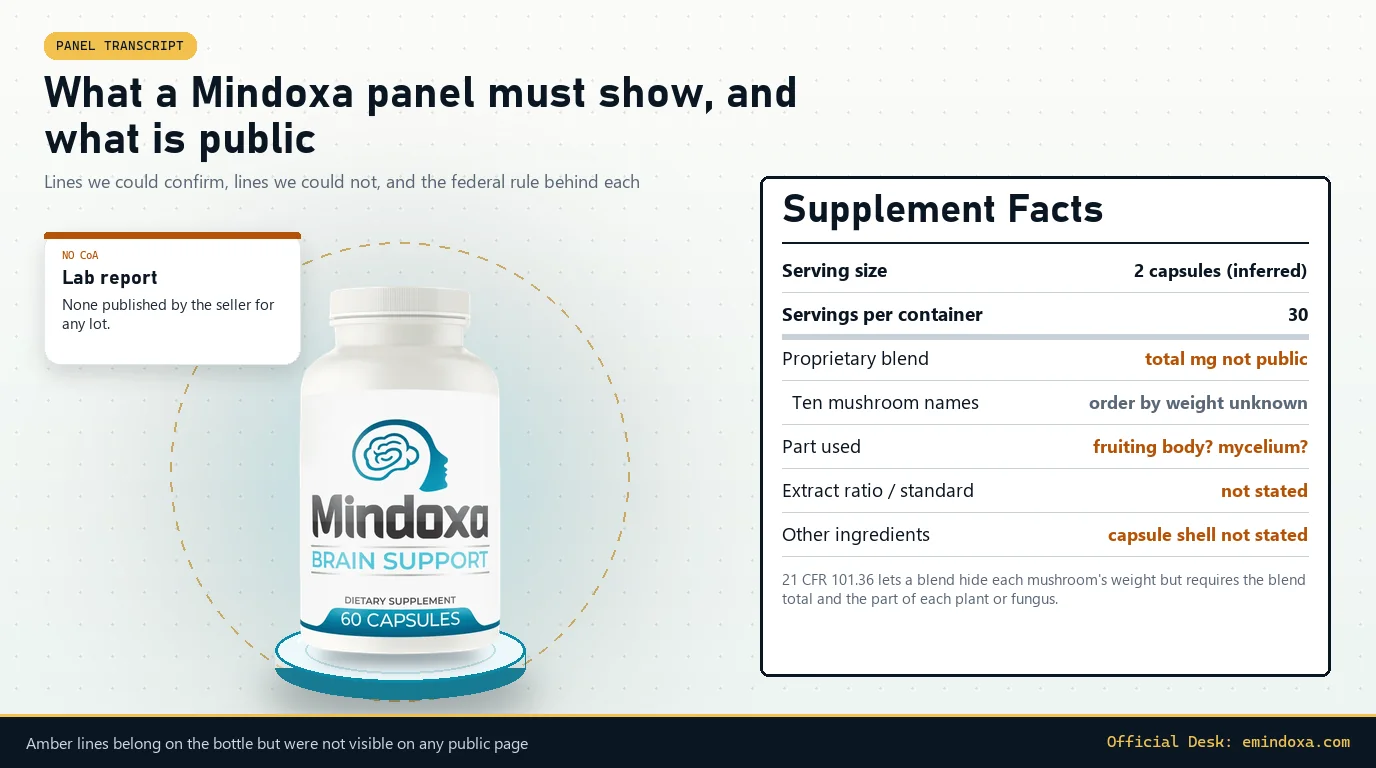
The Mindoxa panel, as far as it is public
No Supplement Facts panel for Mindoxa appears on the seller's presentation, order page or policy pages, and no third-party listing we found shows one. The transcript below is built from what can be read: the bottle front in the seller's product render, the presentation's ingredient chapter, and the pack descriptions on the order page. Amber entries are items federal rules expect on the panel that could not be seen.
Two lines are firm. The bottle front says 60 capsules, and the order page sells six bottles as a "180 Day Supply", three as 90 days and two as 60 days, so each bottle is a 30-day supply and the daily serving is two capsules. The seller's FAQ adds only "take your daily serving as directed on the label, with a glass of water", preferably at breakfast. Everything else on the panel is unknown until you hold a bottle, and that is the single most useful thing to check when it arrives.
Reading the bottle front, line by line
The front of the bottle is the one part of the label anyone can see before buying, so it is worth reading closely. It has four elements.
- The logo and name. A teal profile of a head with a stylized brain inside it, above "Mindoxa" in grey capitals. This is the identity check for counterfeit or lookalike products: the same logo, the same spelling, and no "Pro", "Max" or "Plus" suffix.
- "Brain Support". The only benefit wording on the front. It is a structure-and-function phrase, the kind supplements are allowed to use; on a compliant label it is tied to the standard FDA notice somewhere on the bottle.
- "Dietary Supplement". The statement of identity that tells you which set of rules the product follows. It is not a drug label and carries no approved indication.
- "60 Capsules". The net quantity. It is the anchor for the two-capsule serving, since the seller prices each bottle as 30 days.
What the front does not say is just as informative. There is no "fruiting body", no "organic", no "third-party tested" seal and no milligram figure, all things mushroom brands that compete on quality tend to put up front. The front also shows no lot or expiry, which normally sit on the side or bottom of the bottle.
Three ways a mushroom label can look, and what each lets you check
To make the disclosure question concrete, here are three label styles found across the mushroom supplement market, described generically. They are not other brands' panels; they show what each level of disclosure allows a buyer to do.
| Label style | Typical wording | What you can check |
|---|---|---|
| Fully itemized | "Lion's Mane (Hericium erinaceus) fruiting body extract 1,000 mg, standardized to 25% beta-glucans" | Dose against trials, part used, a marker you can ask to see on a CoA |
| Proprietary blend with total | "Mushroom Complex 900 mg: Lion's Mane, Reishi, Cordyceps..." | Upper limit for each ingredient, rank order by weight, rough even-split arithmetic |
| Names only | A list of mushroom names with no weights | Nothing beyond which species to research and screen for interactions |
On public pages, Mindoxa sits in the third row. If your bottle's panel turns out to be in the second row, the calculator further down this page will tell you the most any one mushroom could be; if it is in the first row, you can compare it with the trials directly and this page's warnings about missing data no longer apply to you. Either way, write down what you find before the first capsule, because the bottle is the only description of the product that the law holds the seller to.
The federal rules a mushroom panel must follow
Dietary supplement labels in the United States follow 21 CFR 101.36[1]. In plain terms, the panel must show:
- Serving size and servings per container, stated in the unit you take, here capsules.
- Each dietary ingredient with its amount per serving. Ingredients with no established Daily Value, which includes every mushroom, are listed with an amount and a dagger instead of a percentage.
- Proprietary blends as an alternative: a named blend may list its ingredients in descending order of weight without individual amounts, but must give the blend's total weight. That is the rule that lets a ten-mushroom blend hide each mushroom's share, and it is why the blend total is the minimum a buyer should expect to see.
- The part of the plant for botanical ingredients, such as root, leaf or, for fungi, fruiting body or mycelium.
- Other ingredients, in a separate list below the panel: the capsule shell (gelatin or a vegetarian material such as hypromellose or pullulan) and any flow agents.
Two further rules shape what the label may say. A structure-and-function claim such as "brain support" is allowed if it carries the standard notice that the FDA has not evaluated it and the product is not intended to diagnose, treat, cure or prevent any disease; a claim to prevent Alzheimer's disease would be a disease claim and is not allowed[2]. And the manufacturer must follow current good manufacturing practice, including testing the identity of every dietary ingredient and setting specifications for purity, strength and composition[3], but nothing requires it to publish those results. The FDA does not approve supplements or their labels before sale[4].
What a good mushroom label adds
Beyond the legal minimum, the best mushroom products print information that lets you compare them with research. If your Mindoxa bottle shows any of the following, it is a good sign; if it shows none, you have learned something too.
Species in Latin, and the part
"Lion's Mane (Hericium erinaceus) fruiting body" tells you far more than "Lion's Mane". For Cordyceps, the species is essential: C. militaris and fermented Cs-4 mycelium are different organisms with different chemistry.
Extract type and ratio
"Hot water extract", "dual extract (water and ethanol)" or "8:1 extract" describes how the material was concentrated. Ratios describe the raw material the manufacturer says it started from, which cannot be verified from the label, so a marker percentage is more useful.
Marker compounds with a method
"Standardized to 30% beta-glucans" means more if the method is named, because some older tests counted starch as glucan. Specific enzymatic methods separate beta-glucan from alpha-glucan; a laboratory survey using them found grain-grown mycelial products high in alpha-glucan (starch) and low in beta-glucan[5]. For Lion's Mane, an erinacine A content in mg per gram, as in the 2020 Alzheimer's pilot, is the gold standard[7].
Dose per serving for the lead ingredient
Even inside a blend, some makers state the lead ingredient's amount. For Lion's Mane, that number can be compared directly with the 3 grams a day of the main trial[6].
Reading the seller's other label claims
The presentation's FAQ describes Mindoxa as "100% natural", vegetarian, non-GMO, and "completely free from gluten, dairy, soy, preservatives, fillers, and artificial chemicals", manufactured in the United States "under strict quality controls". Each claim is worth a short note.
- Vegetarian implies a non-gelatin capsule shell. The "Other ingredients" line will name it.
- Gluten-free deserves a question if the mycelium was grown on grain such as oats or barley. Ask how it was tested if you have celiac disease.
- No fillers is hard to verify. Encapsulation machines usually need a small amount of a flow agent; some brands use rice flour or rice hulls and count them as "not fillers".
- Manufactured in the United States says where the capsules were filled, not where the mushrooms were grown. Much of the world's mushroom extract is produced in China; the label is not required to say so.
- "100% natural" has no legal definition for supplements and says nothing about safety; chaga's oxalate is natural too[8].
Your label worksheet: ten questions for your own bottle
When your parcel arrives, answer these from the bottle. Photograph the label first so you have a record.
- Is there a Supplement Facts panel, and does it say 2 capsules per serving and 30 servings?
- Is there a blend name and a total weight in mg? Write it down.
- In what order are the ten mushrooms listed? The first is the largest by weight.
- Does each mushroom name its part: fruiting body, mycelium, or "mycelium on organic brown rice" or similar?
- Does any entry say "extract", with a ratio or a standardization?
- Is Cordyceps given a species name?
- What does the "Other ingredients" line list?
- Is there an allergen statement or a "manufactured in a facility that also processes" line?
- Are the lot number and expiry date legible, and is the seal intact?
- Do the directions agree with two capsules a day?
Then put the blend weight into the calculator below to see what an even split would give each mushroom, and compare the result with the trial doses.
Blend arithmetic: what an even split would give
Certificates of analysis: what to request
A certificate of analysis (CoA) is a lab report for one production lot. For a mushroom blend, a useful one confirms the identity of each species, reports beta-glucan and alpha-glucan content, gives heavy metals (lead, arsenic, cadmium, mercury) against stated limits, and lists microbial, yeast and mold counts. Some brands publish CoAs by lot number; Mindoxa's seller does not publish any, and this site does not invent lab data.
To request one, email the helpdesk with your lot number and ask for that lot's CoA, including the testing laboratory's name. Keep the bottle sealed until you hear back if the answer would change your decision, since sealed bottles are the cleanest to return. NCCIH's guidance on using supplements wisely makes the same general point: what a product contains is not always what its label says, and asking is reasonable[10].
"Hello, I bought Mindoxa (ClickBank order [ID]). The lot number on my bottle is [lot]. Could you send the certificate of analysis for this lot, the blend weight per serving, the amount of each mushroom, and whether each is fruiting body or mycelium? Thank you."
Why disclosure is part of the evaluation
It is tempting to treat a missing panel as a technicality. For a mushroom product it is the core issue. The research that gives Lion's Mane its reputation is tied to stated preparations and doses; the safety notes for chaga, reishi and sun mushroom are tied to how much people took[8][9]. Without amounts, a buyer cannot connect the product to either. Federal endorsement and advertising guides expect claims to rest on competent evidence for the product as sold[11], and a published panel is the starting point for any such evidence. That is why label disclosure scores 2.5 out of 10 in our editorial score.
Label questions
Where can I find the Mindoxa Supplement Facts label?
It is not published on the seller's pages we could reach. The bottle front shows the name, 'Brain Support', 'Dietary Supplement' and '60 Capsules'. Check the side panel of your bottle when it arrives.
What is the serving size of Mindoxa?
Two capsules a day, inferred from 60 capsules per bottle sold as a 30-day supply. Follow your bottle if it says otherwise.
Is a proprietary blend legal?
Yes. A blend may hide each ingredient's amount, but the panel must give the blend's total weight and list ingredients in descending order by weight.
Why does fruiting body vs. mycelium matter?
Mycelium grown on grain can be largely starch, and the Lion's Mane trials used either fruiting body or a specific standardized mycelium extract. The part used tells you which research applies.
Does Mindoxa have a certificate of analysis?
None is published. Ask the helpdesk for your lot's CoA, including identity, beta-glucan, heavy metal and microbial results.
Sources for this page
Each link opens the original record. Human trials used single mushrooms at stated doses and preparations; none used the Mindoxa blend, whose amounts are unpublished.
- 1Electronic Code of Federal Regulations. 21 CFR 101.36: Nutrition labeling of dietary supplements (proprietary blend rule in paragraph (c)). www.ecfr.gov/current/title-21/chapter-I/subchapter-B/part-101/subpart-C/section-101.36
- 2Electronic Code of Federal Regulations. 21 CFR 101.93: Certain types of statements for dietary supplements (structure/function vs. disease claims). www.ecfr.gov/current/title-21/chapter-I/subchapter-B/part-101/subpart-F/section-101.93
- 3Electronic Code of Federal Regulations. 21 CFR Part 111: Current Good Manufacturing Practice for dietary supplements. www.ecfr.gov/current/title-21/chapter-I/subchapter-B/part-111
- 4U.S. Food and Drug Administration. Questions and Answers on Dietary Supplements. www.fda.gov/food/information-consumers-using-dietary-supplements/questions-and-answers-dietary-supplements
- 5McCleary BV, Draga A. Measurement of β-glucan in mushrooms and mycelial products. J AOAC Int. 2016;99(2):364-373. pubmed.ncbi.nlm.nih.gov/26957216/
- 6Mori K, Inatomi S, Ouchi K, Azumi Y, Tuchida T. Improving effects of the mushroom Yamabushitake (Hericium erinaceus) on mild cognitive impairment: a double-blind placebo-controlled clinical trial. Phytother Res. 2009;23(3):367-372. pubmed.ncbi.nlm.nih.gov/18844328/
- 7Li IC, Chang HH, Lin CH, et al. Prevention of early Alzheimer's disease by erinacine A-enriched Hericium erinaceus mycelia pilot double-blind placebo-controlled study. Front Aging Neurosci. 2020;12:155. pubmed.ncbi.nlm.nih.gov/32581767/
- 8Kikuchi Y, Seta K, Ogawa Y, et al. Chaga mushroom-induced oxalate nephropathy. Clin Nephrol. 2014;81(6):440-444. pubmed.ncbi.nlm.nih.gov/23149251/
- 9National Cancer Institute. Medicinal Mushrooms (PDQ), Health Professional Version. www.cancer.gov/about-cancer/treatment/cam/hp/mushrooms-pdq
- 10National Center for Complementary and Integrative Health. Using Dietary Supplements Wisely. www.nccih.nih.gov/health/using-dietary-supplements-wisely
- 11Electronic Code of Federal Regulations. 16 CFR Part 255: Guides Concerning the Use of Endorsements and Testimonials in Advertising. www.ecfr.gov/current/title-16/chapter-I/subchapter-B/part-255
Run a fair 180-day test of Mindoxa
ClickBank takes the payment. Log your everyday lapses before the first capsule, keep sleep, walking and hearing in the plan, file the receipt email, and if the log looks the same around week 20, post the bottles back while there is still time for them to reach Colorado.