
Mindoxa Ingredients: Ten Mushrooms, Trial Doses and What the Label Leaves Out
Every mushroom the seller names, with what human research found, at what dose and in which preparation, plus the safety flags that apply at any dose.
How this page grades a mushroom list with no amounts
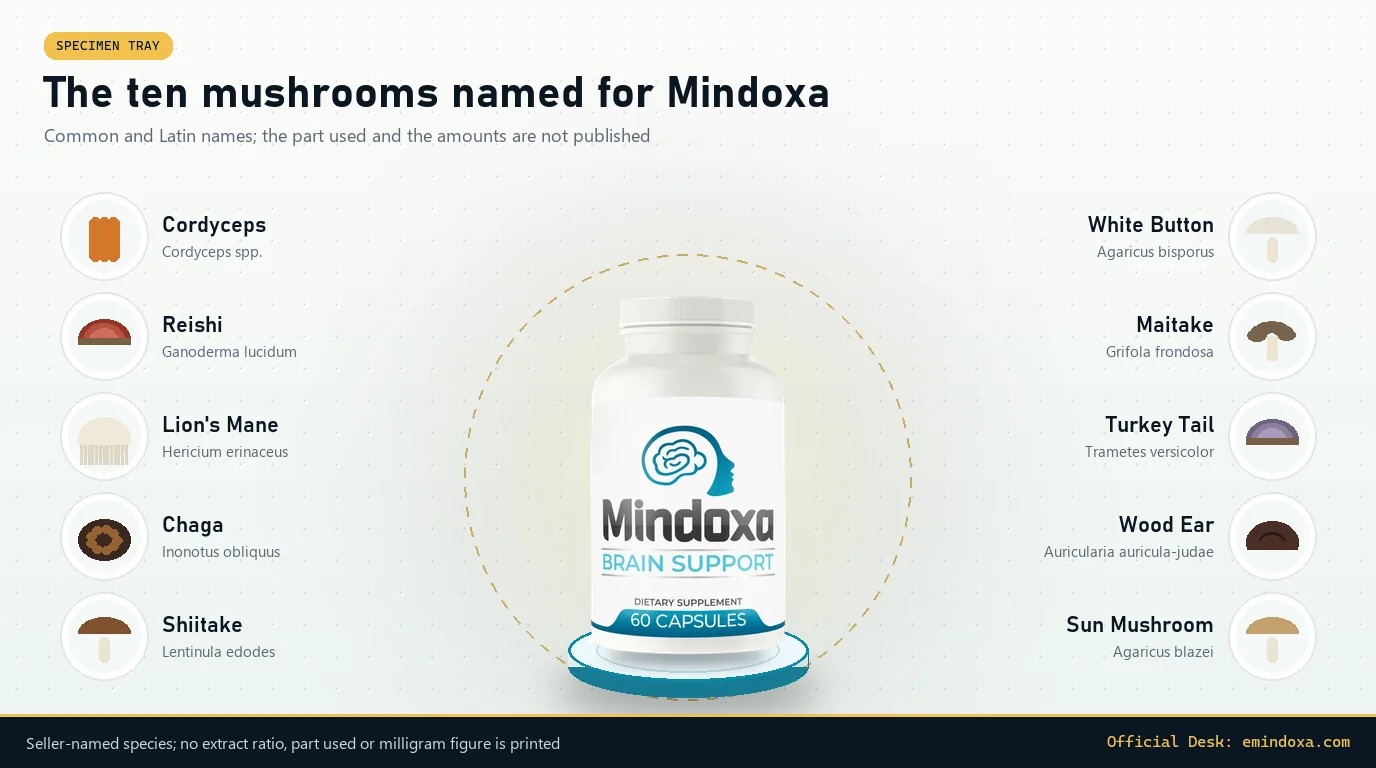
Most ingredient pages for supplements repeat the seller's list and attach a benefit to each name. That does not work for Mindoxa, because nobody outside the company knows how much of any mushroom is in the capsule, which part of the fungus it comes from, or how it was extracted. The seller's presentation names ten mushrooms, assigns each a role in a "memory-saving process", and stops there. No milligram amounts are published, and there is no Supplement Facts panel on any public page we could reach.
So this page asks three questions of every name, the same three a pharmacologist would ask of any botanical. First, what exactly is it: which species, which part (fruiting body, mycelium, or the whole grain block the mycelium grew on), and which extract (hot water, alcohol or both)? Second, what has been shown in people, in which preparation, at what daily dose and for how long? Third, what safety signals exist, regardless of dose? Where the answer to the first question is "not stated", we say so, because it limits how much the answers to the second can tell you.
A fruiting body is the mushroom itself. Mycelium is the thread-like network that produces it. Many U.S. products are made by growing mycelium on rice or oats and drying and grinding the whole thing, so a large share of the powder can be grain starch. A laboratory survey found that such mycelial products had high starch (alpha-glucan) and much lower beta-glucan than fruiting bodies[33]. Federal labeling rules expect the part used to be named for botanical ingredients[35]; check your bottle for it.
The quick version of everything below sits in the ingredients section on the home page. This is the long one, mushroom by mushroom, followed by the compounds behind the names, the gaps in what the seller discloses, and a summary table.
The three lead mushrooms: Lion's Mane, Reishi and Cordyceps
Lion's Mane (Hericium erinaceus)
Lion's Mane is a white, icicle-like mushroom that grows on dead hardwood and is eaten as a delicacy in China and Japan, where it is called yamabushitake. It is the only mushroom in the Mindoxa list with randomized human trials on cognition, which is why it deserves the closest look. Its two families of interesting compounds live in different parts of the organism: hericenones in the fruiting body and erinacines in the mycelium. Both stimulate the synthesis of nerve growth factor in cell and animal experiments, and erinacines cross into the brain more readily in animal work[5].
The human data are small but real. In the 2009 Japanese trial most often cited, 30 men and women aged 50 to 80 with mild cognitive impairment took four 250 mg tablets of dried fruiting-body powder three times a day, 3 grams in all, or placebo, for 16 weeks. Scores on a standard cognitive scale improved more with Lion's Mane at weeks 8, 12 and 16, then fell back significantly within four weeks of stopping[1]. A 2019 Japanese study in healthy adults over 50 reported better performance on a brief cognitive screen after 12 weeks[2]. A 2020 Taiwanese pilot gave about a gram a day of a mycelium extract enriched in erinacine A to people with mild Alzheimer's disease for 49 weeks and reported better scores on several measures than placebo[3]. And a 2023 British pilot in 41 young adults found 1.8 grams a day produced faster performance on one task an hour after a dose, with no overall cognitive improvement after 28 days[4].
What this means for a Mindoxa buyer: the best result came from 3 grams a day of fruiting body, and the second-best from a specific standardized mycelium extract. Two capsules holding about a gram of mixed powder from ten mushrooms cannot supply the first, and the seller does not say it uses the second. Lion's Mane is generally well tolerated; rare allergic reactions, including skin rash and breathing problems, have been reported, as with other mushrooms.
Reishi (Ganoderma lucidum)
Reishi, or lingzhi, is a hard, glossy, kidney-shaped bracket fungus that has been used in East Asian medicine for about two thousand years. It is too woody and bitter to eat, so products are made from hot-water extracts (rich in polysaccharides such as beta-glucans) or alcohol extracts (rich in triterpenes such as ganoderic acids), or both. The presentation credits it with activating CREB and BDNF, two molecules central to memory formation. The study behind that idea exists: polysaccharides from Reishi improved cognitive function and the proliferation of neural progenitor cells in a mouse model of Alzheimer's disease[6]. There is no human trial of Reishi for memory that we could find.
Reishi's largest body of human research is in cancer care, where it is used alongside conventional treatment in parts of Asia. A Cochrane review found the evidence too weak to support it as a first-line treatment, while noting it might help as an add-on[7]. The safety notes are more concrete. Cases of severe liver injury, one fatal, have been linked to reishi powder products[8][9], and Memorial Sloan Kettering's monograph lists possible effects on clotting, blood pressure and blood sugar, which matter for people taking anticoagulants, antihypertensives or diabetes medicines[10].
Cordyceps (species not stated)
The name covers several organisms. Wild Cordyceps sinensis, now classified as Ophiocordyceps sinensis, grows on caterpillar larvae on the Tibetan plateau and sells for thousands of dollars per kilogram, so it is not what goes into mainstream capsules. Supplements use either cultivated Cordyceps militaris or fermented mycelial strains such as Cs-4. The distinction matters for the presentation's claim, which rests on cordycepin: cordycepin is found mainly in C. militaris, and the fermented strains used in many older trials are different organisms[11]. The seller does not say which it uses.
Cordycepin itself is a well-studied molecule in the laboratory, with effects on inflammation, cell signalling and, in rodents, on hippocampal function. Human trials of Cordyceps products, though, have measured physical performance: about 1 gram a day of Cs-4 for 12 weeks modestly improved aerobic thresholds in adults aged 50 to 75, and a C. militaris blend improved tolerance to high-intensity exercise in young adults[12][13]. Memory was not measured. MSKCC notes possible interactions with anticoagulants, diabetes medicines and immune suppressants[14].
The seven 'shield' mushrooms, one by one
The presentation groups the remaining seven as a "protective shield" that defends the memory system against oxidative stress, inflammation, blood sugar swings, immune strain and poor blood flow. None of them has a human memory trial. For each, here is what it is, what the evidence covers and what to watch for.
Chaga (Inonotus obliquus)
Chaga is the black, charcoal-like growth on birch trunks, traditionally brewed as a tea in Russia and Scandinavia. Botanically it is a sterile conk, a mass of fungal tissue rather than a fruiting body, and it is usually wild-harvested. The 2025 study the presentation cites is an animal experiment. The specific human concern is oxalate: chaga contains very high levels, and a woman who took several teaspoons of chaga powder a day for about six months developed oxalate nephropathy, a form of kidney damage[15]. MSKCC also lists possible additive effects with blood thinners and glucose-lowering drugs[16].
Shiitake (Lentinula edodes)
Shiitake is the world's second most cultivated mushroom and a leading dietary source of ergothioneine, an amino acid the body takes up through a dedicated transporter and concentrates in tissues exposed to oxidative stress[17]. Blood ergothioneine falls with age and is lower in older adults with mild cognitive impairment, and low levels predicted faster decline in a memory clinic cohort[18][19]. Those are associations, not proof that taking it helps. In a four-week trial, eating 5 or 10 grams of dried shiitake a day improved several immune markers in healthy young adults[22]. Eating raw or undercooked shiitake can cause "shiitake dermatitis", a whip-like rash that appears a day or two later[23][24].
White Button (Agaricus bisporus)
The ordinary supermarket mushroom, and its brown forms cremini and portobello. It supplies ergothioneine, fiber and, when exposed to UV light during processing, meaningful vitamin D2[25]. The presentation credits it with calming inflammation that "wears down brain tissue"; there is no human trial to support a memory role. The observational studies linking mushroom intake to better cognitive aging mostly reflect common culinary mushrooms like this one eaten as food, in portions far larger than a capsule[20][21].
Maitake (Grifola frondosa)
Maitake, "hen of the woods", grows in frilly clusters at the base of oaks. Its beta-glucan fractions have been studied for immune and blood sugar effects, mostly in animals and small human studies. The presentation assigns it "blood sugar balance". That is the reason for caution: MSKCC notes that maitake may lower blood glucose and add to diabetes medicines, and a published case describes a rise in INR, the clotting test for warfarin, after a patient started maitake extract[27][26].
Turkey Tail (Trametes versicolor)
A thin, banded bracket fungus common on dead wood worldwide. Two extracts from it, PSK and PSP, are used alongside chemotherapy in Japan and China. A phase 1 trial in women who had finished breast cancer radiotherapy found 3, 6 or 9 grams a day of turkey tail mycelium for six weeks well tolerated, with dose-related changes in immune cells[28]. Memory has not been studied. People on immune suppressants or in active cancer treatment should involve their care team before adding it[29].
Wood Ear (Auricularia auricula-judae)
The dark, rubbery, ear-shaped fungus in hot-and-sour soup and many Chinese dishes. The presentation says it "supports blood flow". The best-documented effect is on platelets: in 1980 a physician described spontaneous bruising in a patient who ate large amounts of this fungus, traced it to inhibited platelet aggregation, and named it "Szechwan purpura"[30]. That is a useful property in a dish and an interaction risk for anyone on aspirin, clopidogrel or an anticoagulant.
Sun Mushroom (Agaricus blazei, also A. subrufescens)
An almond-scented relative of the button mushroom, popular in Brazil and Japan, where extracts are widely sold to people with cancer. The presentation says it helps the brain "age under less oxidative strain". There is no cognitive human evidence. A Japanese report described severe liver dysfunction in three cancer patients taking Agaricus blazei extract, and MSKCC lists liver and blood sugar cautions[31][32]. The National Cancer Institute's review of medicinal mushrooms covers this and other species for readers who want the oncology side[34].
The compounds behind the names
Mushroom marketing often names compounds rather than doses. Here is what each of the famous ones is, where it is concentrated, and what human data exist. A label that states one of these as a measured percentage, a "marker", is far more informative than a list of species.
| Compound | Main sources in this list | What lab work shows | Human data relevant to memory |
|---|---|---|---|
| Beta-glucans | All ten, highest in fruiting bodies and hot-water extracts | Immune-cell signalling through dectin-1 and related receptors | None for memory; immune markers in small trials[22][28] |
| Hericenones and erinacines | Lion's Mane fruiting body and mycelium | Stimulate nerve growth factor synthesis[5] | Small trials of specific preparations[1][3] |
| Triterpenes (ganoderic acids) | Reishi, alcohol extracts | Anti-inflammatory, liver and hormone effects in models | None for memory |
| Cordycepin | Cordyceps militaris | Wide range of signalling effects in cells and rodents[11] | None for memory |
| Ergothioneine | Shiitake, button, maitake and most edible mushrooms | Antioxidant taken up by a dedicated transporter[17] | Low blood levels track with cognitive decline[18][19] |
| Oxalate | Chaga, very high | Not a benefit; binds calcium | Kidney injury with heavy intake[15] |
The pattern is consistent: the molecules are real and interesting, the strongest data are from cells and animals, and the human evidence for memory concentrates on one mushroom, Lion's Mane, in specific preparations.
What the seller leaves out, and why each gap matters
Seven pieces of information would let an informed buyer judge Mindoxa's ingredients. None is published.
- Amount of each mushroom, or at least the blend total. Without it, nobody can compare the capsule with the trials. Federal rules require a proprietary blend's total weight on the panel[35].
- Part used. Fruiting body, mycelium, or mycelium with its grain substrate. This decides how much of the powder is mushroom at all[33].
- Extraction. Hot water, alcohol or dual extract, and the extract ratio. Reishi triterpenes and Lion's Mane erinacines need alcohol; beta-glucans need hot water.
- Marker content. A measured percentage of beta-glucans, triterpenes or erinacine A, tested by a named method.
- Cordyceps species. Cordycepin, the basis of the stage-one claim, depends on it[11].
- Source and contaminant testing. Wild-harvested fungi such as chaga can take up metals from their environment, so a lot-level heavy-metal result is a reasonable request.
- Other ingredients. The capsule shell and any flow agents. The seller says "no fillers", but most capsules need some excipient to run on a machine.
The Supplement Facts page turns these into a worksheet you can use with your own bottle and an email you can send to the helpdesk.
Ingredient-by-ingredient summary
| Mushroom | Role claimed by the seller | Best human evidence | Dose studied | Main caution |
|---|---|---|---|---|
| Lion's Mane | "Build the storage" | Small trials in MCI, mild Alzheimer's, healthy adults | 1 to 3 g a day | Allergy (rare) |
| Reishi | "Activate the memory pathway" | Mouse studies for memory; cancer adjunct data | None for memory | Rare liver injury; clotting, blood pressure, glucose |
| Cordyceps | "Power up the save signal" | Exercise trials | About 1 g a day or more | Blood thinners, glucose, immune drugs |
| Chaga | Protective antioxidant | None in humans | None | Oxalate kidney injury |
| Shiitake | Ergothioneine source | Food and immune-marker trials | 5 to 10 g dried, as food | Shiitake dermatitis |
| White Button | Calms inflammation | Food-intake associations | Food portions | Mushroom allergy |
| Maitake | Blood sugar balance | Small glucose studies | Not standardized | Glucose lowering; warfarin INR |
| Turkey Tail | Immune protection | Phase 1 trial in cancer care | 3 to 9 g a day | Immune suppressants, chemotherapy |
| Wood Ear | Blood flow | Platelet case report | Food amounts | Bleeding with antiplatelets |
| Sun Mushroom | Less oxidative strain | Cancer-patient use, case reports | Not standardized | Liver injury reports |
Ingredient questions
Which ingredient in Mindoxa has the best evidence for memory?
Lion's Mane. It is the only one of the ten with randomized human trials on cognition, and the most cited used 3 grams a day of fruiting-body powder for 16 weeks in adults with mild cognitive impairment.
Does Mindoxa use fruiting bodies or mycelium?
The seller does not say. This matters because mycelium grown on grain can be mostly starch, and the Lion's Mane trials used either fruiting body or a specific erinacine-enriched mycelium.
How much Lion's Mane is in Mindoxa?
No amount is published. Two capsules shared by ten mushrooms hold roughly a gram of powder in total, which is well below the 3 grams a day used in the main trial unless a concentrated extract is used.
Are any Mindoxa ingredients risky?
Most are foods or well-tolerated medicinal mushrooms. The specific cautions are bleeding risk with wood ear, maitake and reishi, blood sugar effects with maitake, reishi and chaga, kidney concerns with chaga's oxalate, and rare liver injury with reishi and sun mushroom.
Is Mindoxa vegan and gluten-free?
The seller says it is vegetarian, non-GMO and free from gluten, dairy and soy. If the mycelium is grown on grain, ask the helpdesk how gluten was tested, especially if you have celiac disease.
Sources for this page
Each link opens the original record. Human trials used single mushrooms at stated doses and preparations; none used the Mindoxa blend, whose amounts are unpublished.
- 1Mori K, Inatomi S, Ouchi K, Azumi Y, Tuchida T. Improving effects of the mushroom Yamabushitake (Hericium erinaceus) on mild cognitive impairment: a double-blind placebo-controlled clinical trial. Phytother Res. 2009;23(3):367-372. pubmed.ncbi.nlm.nih.gov/18844328/
- 2Saitsu Y, Nishide A, Kikushima K, Shimizu K, Ohnuki K. Improvement of cognitive functions by oral intake of Hericium erinaceus. Biomed Res. 2019;40(4):125-131. pubmed.ncbi.nlm.nih.gov/31413233/
- 3Li IC, Chang HH, Lin CH, et al. Prevention of early Alzheimer's disease by erinacine A-enriched Hericium erinaceus mycelia pilot double-blind placebo-controlled study. Front Aging Neurosci. 2020;12:155. pubmed.ncbi.nlm.nih.gov/32581767/
- 4Docherty S, Doughty FL, Smith EF. The acute and chronic effects of Lion's Mane mushroom supplementation on cognitive function, stress and mood in young adults: a double-blind, parallel groups, pilot study. Nutrients. 2023;15(22):4842. pubmed.ncbi.nlm.nih.gov/38004235/
- 5Friedman M. Chemistry, nutrition, and health-promoting properties of Hericium erinaceus (Lion's Mane) mushroom fruiting bodies and mycelia and their bioactive compounds. J Agric Food Chem. 2015;63(32):7108-7123. pubmed.ncbi.nlm.nih.gov/26244378/
- 6Huang S, Mao J, Ding K, et al. Polysaccharides from Ganoderma lucidum promote cognitive function and neural progenitor proliferation in mouse model of Alzheimer's disease. Stem Cell Reports. 2017;8(1):84-94. pubmed.ncbi.nlm.nih.gov/28076758/
- 7Jin X, Ruiz Beguerie J, Sze DM, Chan GC. Ganoderma lucidum (Reishi mushroom) for cancer treatment. Cochrane Database Syst Rev. 2016;4(4):CD007731. pubmed.ncbi.nlm.nih.gov/27045603/
- 8Wanmuang H, Leopairut J, Kositchaiwat C, Wananukul W, Bunyaratvej S. Fatal fulminant hepatitis associated with Ganoderma lucidum (Lingzhi) mushroom powder. J Med Assoc Thai. 2007;90(1):179-181. pubmed.ncbi.nlm.nih.gov/17621752/
- 9Yuen MF, Ip P, Ng WK, Lai CL. Hepatotoxicity due to a formulation of Ganoderma lucidum (lingzhi). J Hepatol. 2004;41(4):686-687. pubmed.ncbi.nlm.nih.gov/15464254/
- 10Memorial Sloan Kettering Cancer Center, About Herbs. Reishi Mushroom. www.mskcc.org/cancer-care/integrative-medicine/herbs/reishi-mushroom
- 11Tuli HS, Sharma AK, Sandhu SS, Kashyap D. Cordycepin: a bioactive metabolite with therapeutic potential. Life Sci. 2013;93(23):863-869. pubmed.ncbi.nlm.nih.gov/24121015/
- 12Chen S, Li Z, Krochmal R, Abrazado M, Kim W, Cooper CB. Effect of Cs-4 (Cordyceps sinensis) on exercise performance in healthy older subjects: a double-blind, placebo-controlled trial. J Altern Complement Med. 2010;16(5):585-590. pubmed.ncbi.nlm.nih.gov/20804368/
- 13Hirsch KR, Smith-Ryan AE, Roelofs EJ, Trexler ET, Mock MG. Cordyceps militaris improves tolerance to high-intensity exercise after acute and chronic supplementation. J Diet Suppl. 2017;14(1):42-53. pubmed.ncbi.nlm.nih.gov/27408987/
- 14Memorial Sloan Kettering Cancer Center, About Herbs. Cordyceps. www.mskcc.org/cancer-care/integrative-medicine/herbs/cordyceps
- 15Kikuchi Y, Seta K, Ogawa Y, et al. Chaga mushroom-induced oxalate nephropathy. Clin Nephrol. 2014;81(6):440-444. pubmed.ncbi.nlm.nih.gov/23149251/
- 16Memorial Sloan Kettering Cancer Center, About Herbs. Chaga Mushroom. www.mskcc.org/cancer-care/integrative-medicine/herbs/chaga-mushroom
- 17Cheah IK, Halliwell B. Ergothioneine; antioxidant potential, physiological function and role in disease. Biochim Biophys Acta. 2012;1822(5):784-793. pubmed.ncbi.nlm.nih.gov/22001064/
- 18Cheah IK, Feng L, Tang RMY, Lim KHC, Halliwell B. Ergothioneine levels in an elderly population decrease with age and incidence of cognitive decline; a risk factor for neurodegeneration? Biochem Biophys Res Commun. 2016;478(1):162-167. pubmed.ncbi.nlm.nih.gov/27444382/
- 19Wu LY, Kan CN, Cheah IK, et al. Low plasma ergothioneine predicts cognitive and functional decline in an elderly cohort attending memory clinics. Antioxidants (Basel). 2022;11(9). pubmed.ncbi.nlm.nih.gov/36139790/
- 20Feng L, Cheah IK, Ng MM, et al. The association between mushroom consumption and mild cognitive impairment: a community-based cross-sectional study in Singapore. J Alzheimers Dis. 2019;68(1):197-203. pubmed.ncbi.nlm.nih.gov/30775990/
- 21Zhang S, Tomata Y, Sugiyama K, Sugawara Y, Tsuji I. Mushroom consumption and incident dementia in elderly Japanese: the Ohsaki Cohort 2006 Study. J Am Geriatr Soc. 2017;65(7):1462-1469. pubmed.ncbi.nlm.nih.gov/28295137/
- 22Dai X, Stanilka JM, Rowe CA, et al. Consuming Lentinula edodes (Shiitake) mushrooms daily improves human immunity: a randomized dietary intervention in healthy young adults. J Am Coll Nutr. 2015;34(6):478-487. pubmed.ncbi.nlm.nih.gov/25866155/
- 23Boels D, Landreau A, Bruneau C, et al. Shiitake dermatitis recorded by French Poison Control Centers: new case series with clinical observations. Clin Toxicol (Phila). 2014;52(6):625-628. pubmed.ncbi.nlm.nih.gov/24940644/
- 24Memorial Sloan Kettering Cancer Center, About Herbs. Shiitake Mushroom. www.mskcc.org/cancer-care/integrative-medicine/herbs/shiitake-mushroom
- 25Cardwell G, Bornman JF, James AP, Black LJ. A review of mushrooms as a potential source of dietary vitamin D. Nutrients. 2018;10(10):1498. pubmed.ncbi.nlm.nih.gov/30322118/
- 26Hanselin MR, Vande Griend JP, Linnebur SA. INR elevation with maitake extract in combination with warfarin. Ann Pharmacother. 2010;44(1):223-224. pubmed.ncbi.nlm.nih.gov/20040699/
- 27Memorial Sloan Kettering Cancer Center, About Herbs. Maitake. www.mskcc.org/cancer-care/integrative-medicine/herbs/maitake
- 28Torkelson CJ, Sweet E, Martzen MR, et al. Phase 1 clinical trial of Trametes versicolor in women with breast cancer. ISRN Oncol. 2012;2012:251632. pubmed.ncbi.nlm.nih.gov/22701186/
- 29Memorial Sloan Kettering Cancer Center, About Herbs. Coriolus Versicolor (Turkey Tail). www.mskcc.org/cancer-care/integrative-medicine/herbs/coriolus-versicolor
- 30Hammerschmidt DE. Szechwan purpura. N Engl J Med. 1980;302(21):1191-1193. pubmed.ncbi.nlm.nih.gov/7189247/
- 31Mukai H, Watanabe T, Ando M, Katsumata N. An alternative medicine, Agaricus blazei, may have induced severe hepatic dysfunction in cancer patients. Jpn J Clin Oncol. 2006;36(12):808-810. pubmed.ncbi.nlm.nih.gov/17105737/
- 32Memorial Sloan Kettering Cancer Center, About Herbs. Agaricus. www.mskcc.org/cancer-care/integrative-medicine/herbs/agaricus
- 33McCleary BV, Draga A. Measurement of β-glucan in mushrooms and mycelial products. J AOAC Int. 2016;99(2):364-373. pubmed.ncbi.nlm.nih.gov/26957216/
- 34National Cancer Institute. Medicinal Mushrooms (PDQ), Health Professional Version. www.cancer.gov/about-cancer/treatment/cam/hp/mushrooms-pdq
- 35Electronic Code of Federal Regulations. 21 CFR 101.36: Nutrition labeling of dietary supplements (proprietary blend rule in paragraph (c)). www.ecfr.gov/current/title-21/chapter-I/subchapter-B/part-101/subpart-C/section-101.36
Run a fair 180-day test of Mindoxa
ClickBank takes the payment. Log your everyday lapses before the first capsule, keep sleep, walking and hearing in the plan, file the receipt email, and if the log looks the same around week 20, post the bottles back while there is still time for them to reach Colorado.