
How Mindoxa Works: Long-Term Potentiation, Three Mushroom 'Stages' and the Evidence
The presentation builds a three-stage story on real neuroscience. Here is the neuroscience told straight, each stage checked against the studies, and what has actually improved memory in trials.
How memories are actually made
Before testing any mechanism claim it helps to have the basic model straight. Memory researchers describe three phases. Encoding is taking information in, which depends heavily on attention: a name heard while you are distracted is barely encoded at all. Consolidation is the process by which a fragile new trace becomes stable, which involves the hippocampus early on and is strongly supported by sleep, especially deep slow-wave sleep[2]. Retrieval is getting the memory back when you need it, and it is the phase most affected by normal aging: the name is stored, but it takes longer to reach.
The Mindoxa presentation simplifies this into a single "save button". As a teaching image it is not bad, since consolidation really does decide what lasts. Its weakness is that most everyday lapses people worry about, walking into a room and forgetting why, losing a name mid-sentence, are failures of attention at encoding or slowness at retrieval rather than a broken save mechanism. That is why the most effective fixes are often unglamorous: sleep, hearing, fewer sedating medicines, less multitasking[25].
Long-term potentiation: the real science behind the 'save button'
Long-term potentiation is a lasting increase in the strength of a synapse after it is activated in a particular pattern. It was first reported in 1973 in the hippocampus of anesthetized rabbits and has since become one of the most studied phenomena in neuroscience; the 1993 review by Bliss and Collingridge is still a standard reference[1]. The core sequence is well mapped. Glutamate released by one neuron activates NMDA receptors on the next only when that neuron is already depolarized, which makes the receptor a coincidence detector. Calcium flows in, enzymes such as CaMKII are switched on, and more AMPA receptors are inserted into the synapse, so the same signal produces a larger response. That is early LTP, lasting an hour or two.
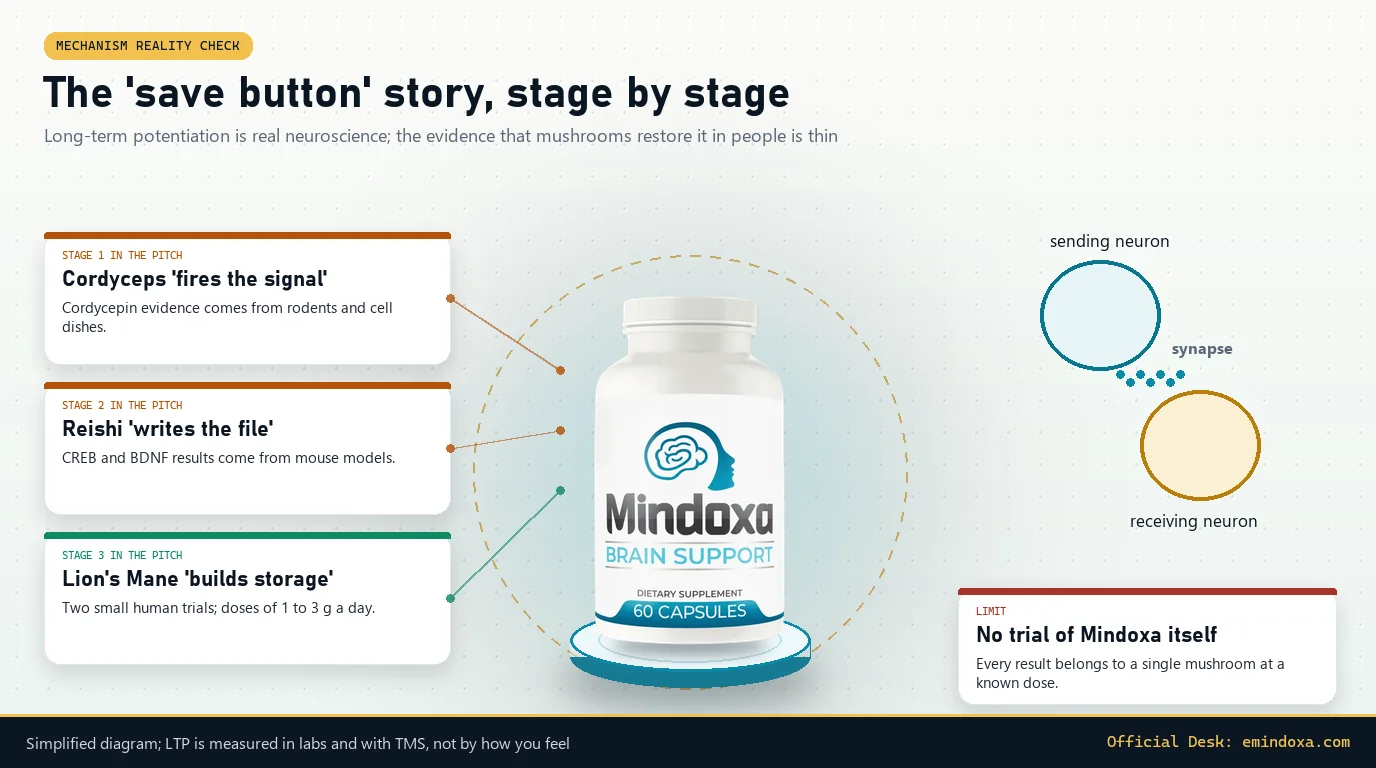
Late LTP, which can last days to months, requires new proteins. Here the transcription factor CREB and the growth factor BDNF do appear, as the presentation says: CREB switches on genes needed for structural change, and BDNF supports the growth of new connection points on dendrites. These are textbook steps. What the presentation adds is the idea that three mushrooms map neatly onto three stages, Cordyceps for the signal, Reishi for the CREB and BDNF step, Lion's Mane for the structure. That mapping is a marketing structure, not a finding from any study.
In living people, researchers can estimate an "LTP-like" response in the cortex with transcranial magnetic stimulation (TMS): a patterned train of magnetic pulses normally increases the size of a muscle twitch evoked afterwards. In people with Alzheimer's disease that increase is reduced or absent, regardless of age at onset, as a 2016 study from Rome showed[3]. The presentation describes Harvard and Milan studies with similar themes but cites neither, so their specific figures, "zero" response and "five times more likely", could not be checked. More importantly, none of this research tested a supplement.
Stage one: does Cordyceps 'power up the signal'?
The claim: cordycepin rebuilds damaged wiring in the hippocampus, strengthens firing between neurons and grows new dendritic spines, and preserves memory against amyloid in a second study. The evidence: cordycepin (3'-deoxyadenosine) does have effects on neuronal signalling and inflammation in cell and rodent experiments, reviewed broadly by Tuli and colleagues[4]. Those experiments usually apply purified cordycepin at defined concentrations, which is different from swallowing a small share of mushroom powder whose cordycepin content is unstated.
In humans, Cordyceps trials have looked at exercise. About 1 gram a day of the fermented Cs-4 strain for 12 weeks raised metabolic and ventilatory thresholds modestly in healthy adults aged 50 to 75, and a C. militaris product improved tolerance to high-intensity exercise in younger adults[5][6]. A real but different effect. There is no human trial showing improved memory or synaptic function with any Cordyceps product, and the seller does not say which species it uses. Verdict for stage one: plausible laboratory biology, no human memory evidence.
Stage two: does Reishi switch on CREB and BDNF?
The claim: a study in Scientific Reports showed Reishi directly activating CREB and increasing BDNF in the hippocampus and supporting new brain cells, even in brains with Alzheimer's-type damage. The closest published work we found is a 2017 mouse study in which Reishi polysaccharides promoted neural progenitor proliferation and improved cognitive performance in a transgenic Alzheimer's model[7]. Transgenic mice are an important research tool and a poor predictor of human results; dozens of compounds that helped them failed in people.
Reishi's human research is concentrated elsewhere, mainly in cancer care, and even there a Cochrane review rated the evidence weak[8]. Its triterpenes and polysaccharides differ by extraction method, so a powder and an alcohol extract are not interchangeable. Verdict for stage two: a mouse result presented as a mechanism in people.
Stage three: does Lion's Mane 'build the storage'?
This is the strongest of the three claims. Nerve growth factor supports the survival and maintenance of neurons, including the cholinergic neurons that decline early in Alzheimer's disease. Hericenones from Lion's Mane fruiting bodies and erinacines from its mycelium stimulate NGF synthesis in cultured cells, and erinacines showed effects on the brain in animal studies[9].
The human trials are where the claim earns some credit. In 30 adults with mild cognitive impairment, 3 grams a day of fruiting-body powder for 16 weeks improved cognitive scale scores more than placebo, and the benefit faded within a month of stopping[10]. A 12-week trial in healthy older adults reported a small advantage on a brief screening test[11], a 49-week pilot of an erinacine A-enriched mycelium in mild Alzheimer's disease reported benefit on several scales[12], and a 28-day trial in young adults at 1.8 grams a day found a faster response on one task with no overall cognitive gain[13]. All are small, two are from a single country, and each used a defined preparation at a stated dose.
So the honest version of stage three is: one mushroom in Mindoxa has encouraging early human data, at doses that are probably larger than a share of two capsules can deliver, and the effect appears to last only as long as people keep taking it. The presentation's "rebuilds the storage where memories live" is a large stretch from that.
The 'protective shield': what the other seven are said to do
The presentation assigns the remaining seven mushrooms five protective jobs. Taking them in turn:
- Oxidative stress (Chaga, Sun Mushroom, Shiitake). Oxidative damage is part of brain aging, but antioxidant supplements in general have a poor record in cognitive trials. Ergothioneine from shiitake is the most interesting case: low blood levels track with cognitive decline, which suggests a link worth testing, not a proven benefit[14][15].
- Inflammation (White Button). Chronic inflammation is linked to cognitive decline in observational research. No trial shows button mushroom powder reducing it in the brain. As food, mushrooms track with better cognitive aging in Singapore and Japan[16][17].
- Blood sugar balance (Maitake). Diabetes is a recognized dementia risk factor, and maitake may lower glucose. That is also why it can interact with diabetes medicines; managing blood sugar is a job for diet, activity and, where needed, prescribed treatment[20].
- Immune defense (Turkey Tail). Turkey tail polysaccharides change immune markers. Whether that protects the brain is untested.
- Blood flow (Wood Ear). Wood ear inhibits platelets, which is a mechanism for bleeding as much as for flow[18].
Each job is a real research theme in brain aging. None has been shown to be performed by these mushrooms in a capsule, at undisclosed doses, in people.
What has actually changed memory outcomes in trials
If the goal is to protect memory, it is worth knowing where the human evidence is strongest, because it is not in supplements. In a year-long trial, older adults who walked briskly three days a week increased the size of their hippocampus by about 2 percent and improved spatial memory, while the stretching group's hippocampus shrank[19]. The FINGER trial combined diet, exercise, cognitive training and vascular check-ups for two years and improved cognitive scores in at-risk older adults[21]. In ACHIEVE, hearing aids and counseling slowed cognitive decline by nearly half in older adults at higher risk[22]. And the 2024 Lancet Commission attributes about 45 percent of dementia cases to modifiable factors[20].
Supplements have a much poorer record. Ginkgo, once the most popular memory supplement in America, was tested in 3,069 adults aged 75 and older for about six years and did not reduce dementia[23]. That history is the backdrop against which any memory supplement claim should be read.
Every human trial behind the ten names, in one table
| Mushroom | Trial | Who | Preparation and dose | Result |
|---|---|---|---|---|
| Lion's Mane | Mori 2009 | 30 adults 50-80 with MCI, 16 weeks | Fruiting body powder, 3 g/day | Better scores than placebo; faded after stopping[10] |
| Lion's Mane | Saitsu 2019 | Healthy adults over 50, 12 weeks | Fruiting body tablets | Small advantage on a screening test[11] |
| Lion's Mane | Li 2020 | Mild Alzheimer's disease, 49 weeks | Erinacine A-enriched mycelium, about 1 g/day | Better on several scales; pilot size[12] |
| Lion's Mane | Docherty 2023 | 41 adults 18-45, 28 days | 1.8 g/day | Faster on one task acutely; no overall gain[13] |
| Cordyceps | Chen 2010 | Healthy adults 50-75, 12 weeks | Cs-4 mycelium, about 1 g/day | Modest aerobic gains; memory not measured[5] |
| Cordyceps | Hirsch 2017 | Young adults, 1-3 weeks | C. militaris blend, several g/day | Better high-intensity tolerance; memory not measured[6] |
| Other eight | No human memory trial found. Human data are in immunity, cancer care or diet studies; see the ingredients page. | |||
What evidence would settle the question
A convincing case for Mindoxa would need a randomized, placebo-controlled trial of the finished capsule, with its composition published, in a defined group such as adults over 60 with subjective memory complaints, lasting at least six months, with validated memory tests chosen in advance and enough participants to detect a modest effect. Nothing close to that exists. Until it does, the product sits where the law places it: a supplement that may claim to "support" brain function but may not claim to treat or prevent disease[24].
For an individual buyer, the next best thing is a personal trial: a baseline, a consistent routine, the same rating every four weeks, and a decision before the refund window closes. The lapse log on the home page and the results timeline are built for exactly that. It will not prove anything scientifically, but it will tell you whether you want to keep paying.
Mechanism questions
What is long-term potentiation?
A lasting strengthening of synapses after patterned activity, first described in 1973 and a leading cellular model of memory formation. The Mindoxa presentation calls it the brain's 'save button'.
Can a supplement restore long-term potentiation?
No study in people has shown that any supplement does. TMS research shows reduced LTP-like plasticity in Alzheimer's disease but did not test supplements.
Does Lion's Mane grow new brain cells?
Its compounds stimulate nerve growth factor in cell and animal studies. In people, small trials found modest cognitive score improvements, not measured brain growth.
Is the three-stage model in the presentation scientific?
The biology it borrows is real, but assigning one mushroom to each stage is a marketing structure. No study tested that combination or that sequence.
How long would Mindoxa take to work, if it works?
The main Lion's Mane trial reported effects by 8 to 16 weeks, and they faded within four weeks of stopping. A fair personal trial is about 16 weeks.
Sources for this page
Each link opens the original record. Human trials used single mushrooms at stated doses and preparations; none used the Mindoxa blend, whose amounts are unpublished.
- 1Bliss TV, Collingridge GL. A synaptic model of memory: long-term potentiation in the hippocampus. Nature. 1993;361(6407):31-39. pubmed.ncbi.nlm.nih.gov/8421494/
- 2Rasch B, Born J. About sleep's role in memory. Physiol Rev. 2013;93(2):681-766. pubmed.ncbi.nlm.nih.gov/23589831/
- 3Di Lorenzo F, Ponzo V, Bonnì S, et al. Long-term potentiation-like cortical plasticity is disrupted in Alzheimer's disease patients independently from age of onset. Ann Neurol. 2016;80(2):202-210. pubmed.ncbi.nlm.nih.gov/27255833/
- 4Tuli HS, Sharma AK, Sandhu SS, Kashyap D. Cordycepin: a bioactive metabolite with therapeutic potential. Life Sci. 2013;93(23):863-869. pubmed.ncbi.nlm.nih.gov/24121015/
- 5Chen S, Li Z, Krochmal R, Abrazado M, Kim W, Cooper CB. Effect of Cs-4 (Cordyceps sinensis) on exercise performance in healthy older subjects: a double-blind, placebo-controlled trial. J Altern Complement Med. 2010;16(5):585-590. pubmed.ncbi.nlm.nih.gov/20804368/
- 6Hirsch KR, Smith-Ryan AE, Roelofs EJ, Trexler ET, Mock MG. Cordyceps militaris improves tolerance to high-intensity exercise after acute and chronic supplementation. J Diet Suppl. 2017;14(1):42-53. pubmed.ncbi.nlm.nih.gov/27408987/
- 7Huang S, Mao J, Ding K, et al. Polysaccharides from Ganoderma lucidum promote cognitive function and neural progenitor proliferation in mouse model of Alzheimer's disease. Stem Cell Reports. 2017;8(1):84-94. pubmed.ncbi.nlm.nih.gov/28076758/
- 8Jin X, Ruiz Beguerie J, Sze DM, Chan GC. Ganoderma lucidum (Reishi mushroom) for cancer treatment. Cochrane Database Syst Rev. 2016;4(4):CD007731. pubmed.ncbi.nlm.nih.gov/27045603/
- 9Friedman M. Chemistry, nutrition, and health-promoting properties of Hericium erinaceus (Lion's Mane) mushroom fruiting bodies and mycelia and their bioactive compounds. J Agric Food Chem. 2015;63(32):7108-7123. pubmed.ncbi.nlm.nih.gov/26244378/
- 10Mori K, Inatomi S, Ouchi K, Azumi Y, Tuchida T. Improving effects of the mushroom Yamabushitake (Hericium erinaceus) on mild cognitive impairment: a double-blind placebo-controlled clinical trial. Phytother Res. 2009;23(3):367-372. pubmed.ncbi.nlm.nih.gov/18844328/
- 11Saitsu Y, Nishide A, Kikushima K, Shimizu K, Ohnuki K. Improvement of cognitive functions by oral intake of Hericium erinaceus. Biomed Res. 2019;40(4):125-131. pubmed.ncbi.nlm.nih.gov/31413233/
- 12Li IC, Chang HH, Lin CH, et al. Prevention of early Alzheimer's disease by erinacine A-enriched Hericium erinaceus mycelia pilot double-blind placebo-controlled study. Front Aging Neurosci. 2020;12:155. pubmed.ncbi.nlm.nih.gov/32581767/
- 13Docherty S, Doughty FL, Smith EF. The acute and chronic effects of Lion's Mane mushroom supplementation on cognitive function, stress and mood in young adults: a double-blind, parallel groups, pilot study. Nutrients. 2023;15(22):4842. pubmed.ncbi.nlm.nih.gov/38004235/
- 14Cheah IK, Halliwell B. Ergothioneine; antioxidant potential, physiological function and role in disease. Biochim Biophys Acta. 2012;1822(5):784-793. pubmed.ncbi.nlm.nih.gov/22001064/
- 15Cheah IK, Feng L, Tang RMY, Lim KHC, Halliwell B. Ergothioneine levels in an elderly population decrease with age and incidence of cognitive decline; a risk factor for neurodegeneration? Biochem Biophys Res Commun. 2016;478(1):162-167. pubmed.ncbi.nlm.nih.gov/27444382/
- 16Feng L, Cheah IK, Ng MM, et al. The association between mushroom consumption and mild cognitive impairment: a community-based cross-sectional study in Singapore. J Alzheimers Dis. 2019;68(1):197-203. pubmed.ncbi.nlm.nih.gov/30775990/
- 17Zhang S, Tomata Y, Sugiyama K, Sugawara Y, Tsuji I. Mushroom consumption and incident dementia in elderly Japanese: the Ohsaki Cohort 2006 Study. J Am Geriatr Soc. 2017;65(7):1462-1469. pubmed.ncbi.nlm.nih.gov/28295137/
- 18Hammerschmidt DE. Szechwan purpura. N Engl J Med. 1980;302(21):1191-1193. pubmed.ncbi.nlm.nih.gov/7189247/
- 19Erickson KI, Voss MW, Prakash RS, et al. Exercise training increases size of hippocampus and improves memory. Proc Natl Acad Sci U S A. 2011;108(7):3017-3022. pubmed.ncbi.nlm.nih.gov/21282661/
- 20Livingston G, Huntley J, Liu KY, et al. Dementia prevention, intervention, and care: 2024 report of the Lancet standing Commission. Lancet. 2024;404(10452):572-628. pubmed.ncbi.nlm.nih.gov/39096926/
- 21Ngandu T, Lehtisalo J, Solomon A, et al. A 2 year multidomain intervention of diet, exercise, cognitive training, and vascular risk monitoring versus control to prevent cognitive decline in at-risk elderly people (FINGER): a randomised controlled trial. Lancet. 2015;385(9984):2255-2263. pubmed.ncbi.nlm.nih.gov/25771249/
- 22Lin FR, Pike JR, Albert MS, et al. Hearing intervention versus health education control to reduce cognitive decline in older adults with hearing loss in the USA (ACHIEVE): a multicentre, randomised controlled trial. Lancet. 2023;402(10404):786-797. pubmed.ncbi.nlm.nih.gov/37478886/
- 23DeKosky ST, Williamson JD, Fitzpatrick AL, et al. Ginkgo biloba for prevention of dementia: a randomized controlled trial. JAMA. 2008;300(19):2253-2262. pubmed.ncbi.nlm.nih.gov/19017911/
- 24Electronic Code of Federal Regulations. 21 CFR 101.93: Certain types of statements for dietary supplements (structure/function vs. disease claims). www.ecfr.gov/current/title-21/chapter-I/subchapter-B/part-101/subpart-F/section-101.93
- 25National Institute on Aging. Memory Problems, Forgetfulness, and Aging. www.nia.nih.gov/health/memory-loss-and-forgetfulness/memory-problems-forgetfulness-and-aging
Run a fair 180-day test of Mindoxa
ClickBank takes the payment. Log your everyday lapses before the first capsule, keep sleep, walking and hearing in the plan, file the receipt email, and if the log looks the same around week 20, post the bottles back while there is still time for them to reach Colorado.